

The Formula
Knowledge
and the
Talent
Building digital systems since 1997 across games, artificial intelligence, financial infrastructure, and digital ownership.
$1M+
Enigma Games Revenue
$500K+
Ecosystem Grants
50K+
PlayNFT Creators
Fortune 500
FedEx · Fidelity
4 Domains
Games · Web3 · AI · Finance
The Journey
For 29 years, I have been on a journey of bringing ambitious ideas to life. I have learned to navigate what was possible, what was required, and the best practices recommended at the time.
C++ is my native language, and it shapes my design philosophy: object-oriented systems, reusable infrastructure, clean abstractions, and architecture built to survive beyond a project's lifecycle.
Each idea carried me into new languages, new platforms, and new concepts. Over time, those builds compounded into the career below.
The record below is not a résumé. It is the evidence of what was built, when, and what each build taught.
The Timeline
A history of creation.
Each project marks how it was built, why it mattered, and what it taught.
1997
Bass Creations
Built
The origin of my programming career. A daily obsession with learning Java, HTML, ASM, and C++.
Enthusiasm grew with each idea that became an animated applet, webpage, and application.
I practiced by building pages using Geocities and taking requests from people I met in AOL chat rooms.
Significance
Creating digital products became my passion with every successful compile and every completed request.
This was an age of discovery, excitement, and the growing realization that code could become the primary language of my imagination.
Lesson
Approach every project with the same enthusiasm and curiosity as your first. Follow your creativity. The ideas that you receive will lead the way.
1998
EFL
Built
My first game. Created during a college competition. Text only. No graphics. Built entirely in C++. An ambitious strategy game with multiple game modes and a shared multiplayer leaderboard.
I first called it BFL after my online identity, BaSS. One day, the crazy idea of Enigma Games began to take shape and BFL became EFL. It would eventually launch on mobile phones and BlackBerry as EFL Strategy Football.
Significance
It was my first complete game, my first multiplayer system, and my first use of database technology.
This was my first full-stack development experience, and it shaped the rest of my career.
Lesson
Venture into unfamiliar technology with curiosity. What begins as an experiment may become the foundation for everything that follows.
1999
The Enigma 3D Engine
Built
I built a full 3D game engine from scratch using OpenGL and DirectX. It included 3D Max model import, UI, physics, spatial audio, and networking.
The engine was designed to support multiple types of games, with a focus on modularity and reusability.
In the end, no games were produced using the engine, but the project transformed me from a programmer into a systems architect.
Significance
A crash course in 3D math, file types, graphics pipelines, physics, lighting, network packets, documentation, and memory management.
This is the exact moment in my history where I became the self proclaimed Brilliant Warrior.
I stopped being limited by existing tools and started building my own. For the first time, my technical ability matched the ambition of my ideas.
Lesson
Building from raw materials unlocks your signature path. Start from the fundamentals and build a foundation of understanding. You can't optimize what you don't understand.
2000
Enigma Games founded
Built
In 2000, I officially founded Enigma Games and committed myself to building strategy-based games.
We initially focused on mobile games and eventually expanding to PC, social, and Web3 platforms.
The technologies used over the years include J2ME, Java, C++, C#, Python, PHP, Unity 3D, Javascript, and Blockchain frameworks.
Significance
Enigma Games turned creation into a discipline. I was no longer building only for the excitement of discovery. I was learning how to carry an idea through the full software lifecycle from development and release to operations and marketing.
This was my first taste of commercial success, media exposure, peer recognition, a huge community of loyal gamers, and acquisition offers from investors.
Lesson
Be patient and allow your work on compound. What begins as a small idea can grow into a career, a company, and a legacy.
2005-2008
The shipping years
Built
Between 2005 and 2008, there was an explosion of new games from Enigma Games.
EFL Strategy Football, Warriors, Solved!, Jacks, Arm Wrestling, Whiz Racer, and Wargods Online were all released in this period.
The blazing pace of development propelled Enigma Games to a million-dollar game studio, with a loyal community of players and a reputation for quality and innovation.
Significance
The pattern of pushing the technical limits and experimenting with new technology and platforms carved out a niche for our indie studio to succeed.
Wargods Online emerged as the studio's flagship game, bringing together years of experience in strategy design, multiplayer systems, platform integration, and community building.
Lesson
Consistency builds momentum. Momentum leads to traction. Make consistency a habit. Keep building until success is inevitable.
2009
Plutus - Brilliant Warrior Investments
Built
I built Plutus, an automated trading system for MetaTrader 4, using Python and MQL4.
It was a fully automated trading system that used machine learning to analyze market data and make trades based on that analysis.
After years of hobby trading Forex and other markets, I wanted to explore how machine learning could be applied to financial markets.
Significance
Plutus carried my systemic thinking into the financial domain.
At the time, machine learning was a new concept for me in finance, and the results were significant enough to form a new venture.
This marked the start of a new career in finance using quant engineering, machine learning, and market intelligence.
Lesson
Skills travel across industries. The mathematics I learned while building the Enigma 3D Engine applied to financial markets. The architectural thinking required for multiplayer games carried into automated trading.
2010-2015
Wargods Online: The Social Media Wars
Built
Launched on MySpace and Facebook in 2008, Wargods Online became the central focus of Enigma Games. What began as a simple social strategy RPG grew into a long-running live service with an active community that grew to over 200,000 players at its peak.
The World vs. World frenzy required constant development, balancing, support, marketing, infrastructure management, and community leadership. It became less like a product and more like a living world that needed constant attention.
Wargods Online was built using a LAMP stack with PHP, MySQL, and Javascript.
Significance
Wargods Online generated over $800,000 in total revenue over its lifespan and became the commercial foundation of Enigma Games.
This was the period when I learned what it meant to operate a successful digital system over time. Building the game was only the beginning. The real work was keeping the world alive, maintaining player trust, responding to player requests, and protecting the experience that the community had invested in.
By 2010 the game had broken out, bringing media coverage, industry recognition, and acquisition interest. Enigma Games had moved from an ambitious idea into a proven business.
Lesson
Ideas can be shared. Execution becomes your signature. No one else will build it exactly as you do. Invest in that advantage.
2018-2021
Blockchain Gaming: The Enjin Multiverse
Built
Blockchain development introduced a major shift in game design and distribution. The audience was vastly different from traditional gamers.
Min-Mins launched on iOS and Android, and Shield of Shalwend launched on Steam. Both integrated Enjin-backed assets that players could hold in their own wallets, trade, transfer, and sell for profit.
Web3 development was a new frontier calling for learning GraphQL, Solidity, NFTs, and server infrastructure that was designed around decentralized identity. Five Enigma Games titles were announced for the Enjin Multiverse. Min-Mins and Shield of Shalwend became the launched games that implemented the Enjin integration.
Significance
The emergence of blockchain technology was a big shift in software development. Web3 enabled identity and transfers of value on a shared ledger.
Emails were no longer required for authentication. Items were no longer restricted to one game. Cross-game rewards and shared economies became possible.
I embraced this technology and immediately started building frameworks that leveraged the new capabilities.
Lesson
Embrace change. Learn what new technology makes possible, then reimagine familiar ideas around those capabilities. Design for the audience entering that new world.
2021-2023
PlayNFT: Digital Ownership Infrastructure
Built
I created PlayNFT to connect digital ownership with practical utility across games, applications, and creator communities.
Streamers could create and distribute branded NFTs. Game developers could connect those assets to playable content and benefits.
The platform brought creators, players, developers, marketplaces, APIs, and multiple blockchains into one shared system.
Significance
Min-Mins explored what blockchain assets could do inside a game. PlayNFT moved one layer deeper and built the infrastructure that allowed those assets to travel between creators, games, communities, and chains.
The platform secured more than $500,000 in ecosystem grants and reached more than 50,000 creators. It attracted integration partners and international media coverage across the blockchain gaming industry.
PlayNFT proved that I could move beyond building individual products and design infrastructure for an entire network of participants.
This was also my first experience coordinating a multichain platform across grant programs, blockchain ecosystems, developers, streamers, and digital communities.
Lesson
When an experiment reveals a larger possibility, build the infrastructure that allows others to enter it. Min-Mins was the experiment. PlayNFT was the bridge.
Public Record
Enjin
Ecosystem · December 2021
PlayNFT: Bringing NFTs to Twitch via Efinity
ReadForkast
December 13, 2021
PlayNFT plug-in to enable streamers to offer NFTs on Twitch
ReadBlockchainGamer.biz
August 16, 2022
PlayNFT brings NFTs to Twitch and YouTube streamers
ReadEIN Presswire
Official Announcement · August 17, 2022
PlayNFT Launches NFT Platform for Twitch & YouTube Streamers, Supported by Ripple XRPL Grant
Read2024-Present
Sagitta Protocol: Continuity as Architecture
Built
In 2024, I began building the Sagitta Protocol as financial infrastructure designed to preserve capital, users, and operations through failure.
The original goal was trustless wealth management, but the work revealed a larger problem. Most systems are designed around normal operation. Few are designed for the moment when a chain, token, oracle, bridge, market, operator, or institution fails.
Sagitta expanded into a continuity ecosystem spanning protocol design, risk intelligence, allocation policy, public-surface review, dependency monitoring, agent payments, and onchain banking. Each system approaches the same question from a different direction: what must remain true when the environment changes?
Significance
For the first time, continuity became the subject itself.
Games taught me how to keep a world alive. Enterprise systems taught me reliability, documentation, and accountability. Trading taught me feedback, exposure, and failure modes. Blockchain taught me portable identity and ownership. PlayNFT taught me how to build infrastructure for a network of participants.
Sagitta brought those lessons together into a doctrine and a technical framework. The Three Deaths Doctrine, the Sagitta Continuity Engine, and the emerging continuity primitives gave structure to an idea that had followed my entire career. A system should preserve the people and value inside it, adapt to changing conditions, and maintain a path forward.
Lesson
Design for success, failure, and return. The true measure of a system is what it preserves through every state.
Institutional Experience
Enterprise scale and discipline.
Experience
Alongside building Enigma Games, I worked inside Fortune 500 environments at FedEx and Fidelity. These roles exposed me to systems operating at a scale where reliability, process, security, documentation, and coordination could never be treated as secondary concerns.
Significance
Entrepreneurship taught me how to create from nothing. Corporate experience taught me how established systems manage complexity, risk, accountability, and continuity across large organizations.
The combination shaped how I build today. I understand both the freedom of invention and the discipline required when other people and operations depend on the result.
Lesson
Great ideas need room to grow. Great systems need discipline to endure.
FedEx
2000-2007Lead Developer
fedex.com · Global Trade Manager & Tracking
Full-stack systems and database development on fedex.com, building Global Trade Manager and Tracking - customer-facing systems that move real freight across real borders, where an error has a weight and a destination. Enigma Games was founded and run through these same years.
Fidelity
2014Lead Developer
Cross-platform systems
Brought in to resolve a cross-platform system issue inside a regulated financial environment, where correctness, auditability, and continuity are requirements rather than ambitions.
The Archive
The timeline is the story. The archive is the evidence — every project with its platform, status, and links, collected in one place to inspect.
View the complete body of workThe Builder
How the work was formed.
Early signal
Before I knew what to call it, I wanted to understand how things worked. I opened systems, traced their parts, and rebuilt them in my own way.
The instinct came first. The vocabulary arrived later.
The discipline
Enigma Games taught me completeness. A digital world requires technology, economics, interface, story, operations, community, and years of care after launch.
Building and operating those worlds turned curiosity into a working method.
The expansion
Once I understood the method, I carried it into markets, machine learning, digital ownership, creator infrastructure, and financial continuity.
The domains changed. The underlying questions remained.
The Through-Line
See the system hidden inside the idea. Learn what the idea requires. Build it into form. Then build the bridge that allows others to enter.
Archive · Press · Interviews
Archive artifacts.
Original press coverage and recorded interviews, preserved as evidence.
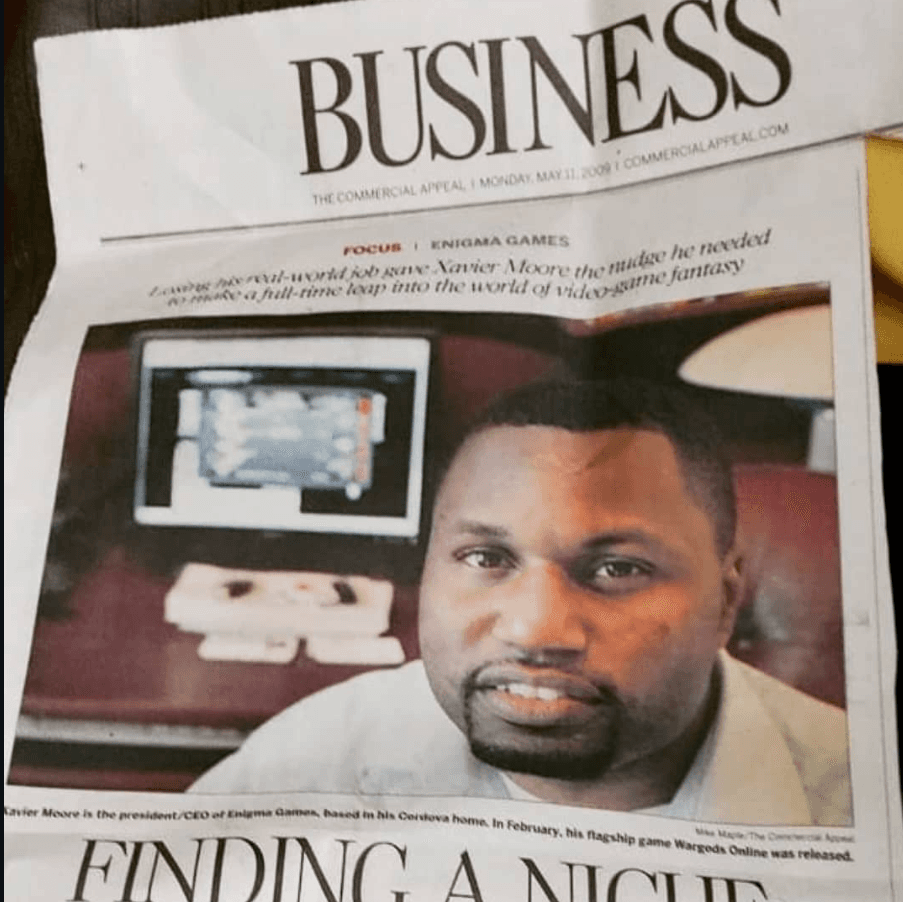
The Commercial Appeal
Business Feature · May 31, 2010
“Finding a Niche”
Front Page coverage of Xavier Moore and Enigma Games during the early mobile and social game era.
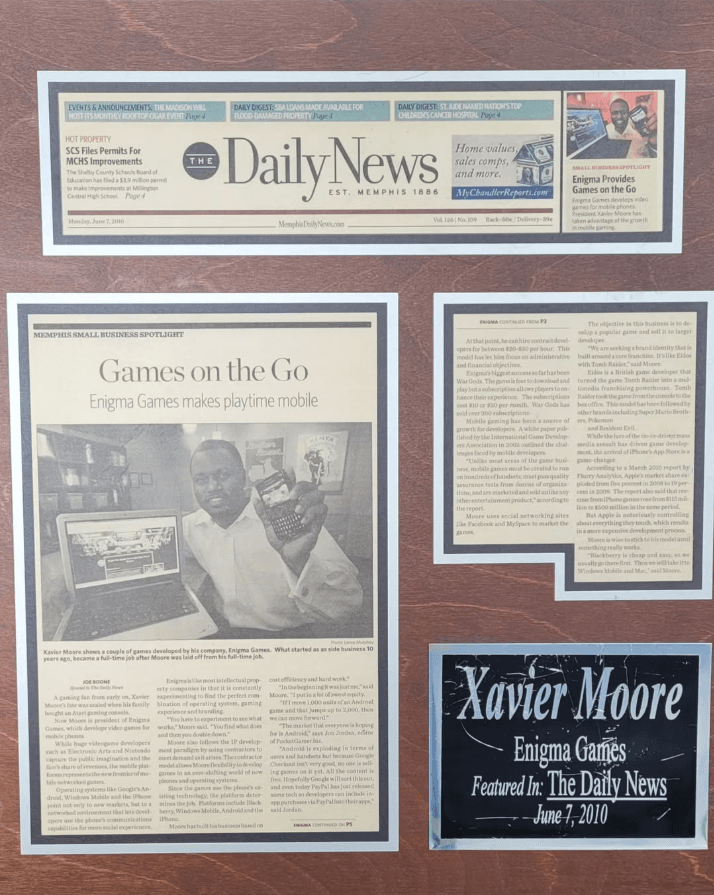
The Daily News
Memphis Small Business Spotlight · June 7, 2010
“Games on the Go”
A feature on Enigma Games bringing playtime mobile during the rise of app-based gaming.
Interviews
Doctrine
What the work taught me.
The years supplied time. The work supplied the lessons.
Ambitious ideas require architecture.
Systems reveal their truth through pressure.
Building the world often comes before building the product.
A strong system preserves the people and value inside it.
The bridge matters as much as the invention.
The Work Continues
The Sagitta Protocol is the most ambitious architecture I have ever attempted.
Continuity, decision intelligence, autonomous allocation, agentic finance, and onchain banking orchestrated into a fiduciary-grade investment engine.
The Idea Is the Assignment. My body of work is the record of obedience to the Principles of Creation.
Xavier D. Moore